How to start a construction business in Dubai 2026: 12 steps to launch on solid ground
How to start a construction business in Dubai 2026: 12 steps to launch on solid ground
Navigate Dubai's construction licensing, mainland company formation, building permits, and investor requirements for profitable growth in the UAE's booming real estate market.
Vincy Amirtharaj
58 post
Senior Business Setup Consultant, Dubai
Thinking about starting a construction business in Dubai? The UAE real estate market in 2026 will undergo significant changes under the Dubai 2040 Urban Master Plan. Its implementation is already creating additional demand for qualified and licensed contractor firms capable of delivering quality infrastructure projects and complete turnkey solutions. Whether planning small residential villa developments or large commercial skyscraper projects, contractors that successfully navigate the changes introduced by Law No. 7 of 2025 will be at the center of creating Dubai's iconic skyline.
It takes much more than a trade licence to create a successful contracting company. Technical competency and a municipal classification are essential in creating a viable strategy for a profitable contracting company. The correct choice of DET business activities, such as Building Contracting, Steel Constructions or Wrecking and Demolition, will determine your ability to tender for government and private sector projects. Understanding the technical requirements of the Dubai Building Code (DBC) and registering with the Society of Engineers (SOE) will help with necessary approvals for technical inspections and attaining the desired municipal classification.
Our 2026 guide offers a detailed strategy for investors, covering all aspects of the contractor rating system, including G+1 to Unlimited categories. We simplify complex requirements such as Dubai Municipality (DM) technical qualification exams, the Wage Protection System (WPS) for employee wage management and Contractor's All Risk Insurance. By positioning your business in accordance with the new Contractor Rating System, you will be able to ensure that your operations are future-proof, expedite building permits and grow your construction company in one of the world's most competitive and rewarding markets.
Typical 12-week construction setup timeline
Week
Authority / Task
Key output
1
DED / DET
Initial Approval & Trade Name Reservation ✓
2
Legal / Notary
Drafting & Signing Memorandum of Association (MoA)
Note: The timeline for construction is longer (10-12 weeks) compared to other sectors because it involves mandatory Dubai Municipality exams and technical classification of your engineering staff.
"The new regulatory framework ensures that only qualified contractors with verified technical capacity can operate, enhancing safety and quality across Dubai's skyline."
- Reference to Dubai Municipality Building Regulation Standards 2026
Step 1: Select your license activity & classification
Your construction license is determined by the "height" or "scope" of projects you intend to handle. You must choose specific activities to match your technical team's expertise:
Building Contracting (G+1, G+4, G+12, Unlimited)
Main category for constructing villas, low-rise, or high-rise buildings.
Building Maintenance
Focused on repair, restoration, and fit-out works (Lighter technical requirements).
Civil Engineering & Infrastructure
Roads, bridges, and sewage networks requiring specialized DM approvals.
Wrecking & Demolition
Specialized activity requiring strict safety permits and environmental NOCs.
Steel Construction Contracting
Focused on warehouses, industrial sheds, and structural steel works.
Pro tip
Starting with a "G+1" (Ground + 1 floor) classification is the most cost-effective entry point. Upgrading to "Unlimited" later requires proving a track record of completed projects and hiring additional senior engineers with 10+ years of UAE experience.
Step 2: Reserve your trade name & legal structure
In the construction sector, your name is your reputation. For a Mainland setup (the only way to bid for most local contracts), your trade name must end in "LLC" or "Limited Liability Company". Avoid restricted words like "Emirates" or "Dubai" unless you meet specific capital requirements. In 2026, the DED (DET) also checks that the name doesn't conflict with existing contractors listed in the new unified Contractor Register.
Quick Fact
As of January 2026, Law No. 7 of 2025 mandates that all contractors must be registered in a centralized Dubai Municipality system. This is integrated with the "Invest in Dubai" portal to ensure unified compliance.
A successful business setup in Dubai hinges on meeting the technical benchmarks set by the DET.
Engineering Technical Staff
Identify a Civil Engineer with UAE-recognized experience. 3 years for G+1, 5 years for G+4, 7+ years for G+12.
Office & Yard Requirements
Minimum 200 sq. ft. office space with Ejari. Some classifications require a storage yard.
Specialized Certifications
Membership in the UAE Society of Engineers (SOE) for all technical staff.
Pro tip
Banks require your Civil Engineer to be on your company's visa (Establishment Card) and registered with Dubai Municipality before they will activate your full "Construction Credit Line" or trade facilities.
Cost snapshot · 2026
DED Initial Approval: AED 236
Trade Name Reservation: AED 736
Mainland Construction Licence: AED 25,000 - 35,000 (Base)
DM Classification Fee: ~AED 10,000
Society of Engineers (SOE) Registration: AED 410 / engineer
Physical Office (Ejari): from AED 25,000 / year
Engineer Visa & Attestation: from AED 7,000
*Prices vary based on classification (G+1 vs Unlimited) and the number of engineering staff.
Construction setup cost estimator (AED)
Estimated setup cost: —
Get technical breakdown on WhatsApp
*Estimates include license fees, municipality classification, and mandatory office Ejari.
"Unlimited" classification requires 3+ senior engineers and additional bank guarantees.
Step 4: Select a legal business structure
For construction, your legal structure dictates your ability to bid on large-scale infrastructure and government projects:
Limited Liability Company (LLC)
The industry standard. Offers 100% foreign ownership while protecting personal assets from high-risk construction liabilities.
Branch of a Foreign Company
Ideal for established international contractors looking to bring their global track record to the Dubai market.
Civil Company
Usually for specialized engineering consultancies; requires a UAE National as a Local Service Agent (LSA).
Sole Establishment
Typically limited to small-scale maintenance or "Handyman" services with lower risk profiles.
Pro tip
While 100% foreign ownership is allowed, most large developers and government entities still prefer contracting with an LLC to ensure local judicial recourse through Dubai Courts.
Plan your construction business setup the right way
Get clarity on licensing and approvals before you commit to your construction company setup.
Under Law No. 7 of 2025, the distinction between Mainland and Free Zone construction has narrowed, as all contractors must now register with the Dubai Municipality unified register.
Mainland (DED / DET)
The "Core" jurisdiction. To build anywhere in the city, from Downtown to Dubai Hills, you need a Mainland license.
Ability to bid for any private or government tender across the entire UAE.
Workforce Scalability
No caps on the number of laborer visas, provided you have the required office space and labor housing.
Building Permits
Direct access to the Dubai Municipality portal for rapid building permit issuance.
Special Development Zones (Free Zones)
When forming company in Dubai free zone, businesses operate under the specific regulations of their chosen authority rather than the general municipality.
Zones like Dubai South or JAFZA have their own building codes (often overseen by Trakhees). However, a Free Zone construction license limits you to working within that specific zone. To undertake projects in the mainland, Free Zone companies can now apply for a temporary permit via the Invest in Dubai (IID) portal.
Ideal for:
Zone-Specific Mastery
Focusing exclusively on industrial projects within JAFZA or logistics hubs in Dubai South.
Logistics & Materials
Exemption from customs duties on imported heavy machinery if kept within the zone.
Trakhees Compliance
Operating under specialized EHS (Environment, Health, and Safety) regulations.
Quick Fact
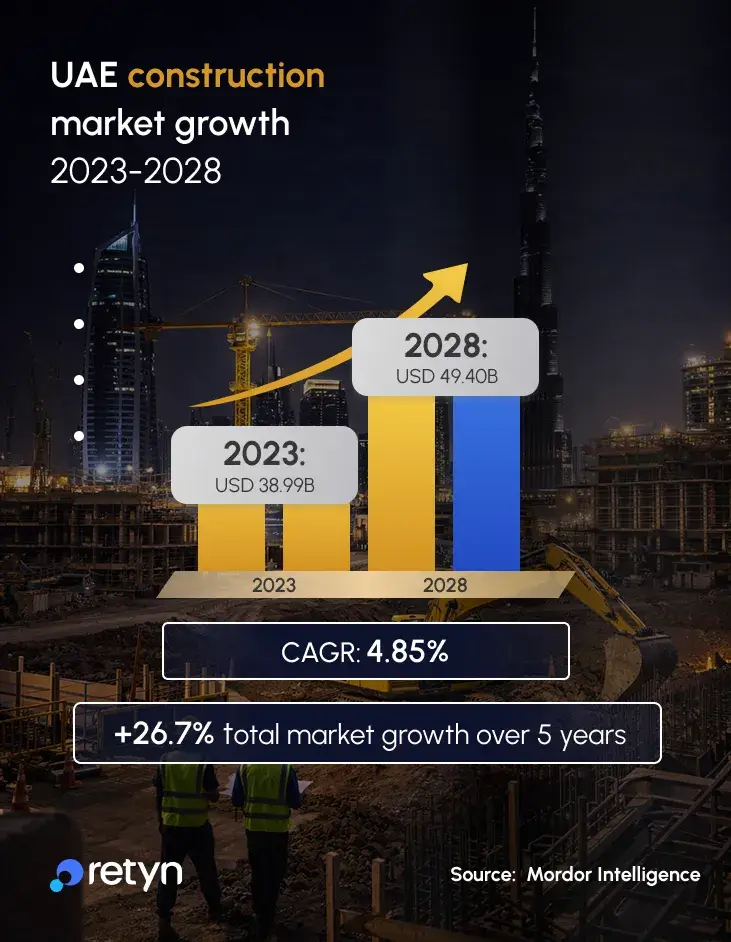
The UAE’s construction industry is poised for significant expansion, with output expected to surge by 22 per cent to $130.8 billion by 2029.
Source: Knight Frank
Step 6: Register & obtain the construction licence
This is a two-gate process: the Trade Licence from DED followed by Technical Classification from Dubai Municipality.
DED (DET) license gate
Initial Approval
Submit partner passports and choose "Building Contracting" or "Steel Works".
MoA Notarization
Draft and sign the Memorandum of Association, specifying technical powers of the manager.
Ejari (Lease)
A physical office is mandatory for construction licenses; no virtual desks allowed.
Dubai Municipality (DM) gate
Engineering Records
Upload attested degrees and CVs of your technical team into the DM system.
DEQ Exams
Designated engineers must pass the Dubai Engineering Qualification (DEQ) interview/exam.
Technical Classification
Receive your category (G+1, G+4, etc.) based on staff competency and experience.
Final Trade Licence
DET issues the final commercial license once the DM technical block is cleared.
Construction licence document checklist
Company & Partners
Passport copies (Clear color copies)
Emirates ID (for UAE residents)
Proof of physical office (Ejari)
Trade Name Reservation certificate
Initial Approval from DET
Notarized MoA / LSA Agreement
Technical / Engineering Staff
Civil Engineering Degree (MOFA Attested)
Society of Engineers (SOE) Membership Card
Professional Competency Certificate (PCC)
Experience Certificates (Min. 3 years for G+1)
Genuineness Certificate (from home country embassy)
Passport & Visa copy of the Engineer
Tip: MOFA attestation requires the degree to be first stamped by the Ministry of Education and Ministry of Foreign Affairs in your home country.
sequenceDiagram
participant Founder
participant DED as DED / DET (Licensing)
participant DM as Dubai Municipality (Technical)
participant Bank
participant Tax as Federal Tax Authority
Founder->>DED: 1 · Reserve Name & Initial Approval
Founder->>DED: 2 · Lease Office (Ejari) & Sign MoA
DED-->>Founder: 3 · Commercial Trade Licence Issued
Founder->>DM: 4 · Upload Engineering Records & Pass DEQ Exams
DM-->>Founder: 5 · Technical Classification Certificate (G+1/G+4)
Founder->>DED: 6 · Apply for Establishment Card (MOHRE/GDRFA)
Founder->>DED: 7 · Process Engineering & Labor Visas
Founder->>Bank: 8 · Submit License, DM Classification & Project Plan
Bank-->>Founder: 9 · Corporate Account Activated
Founder->>Tax: 10 · Register for VAT & Corporate Tax
Note over Founder: 11 · Operational Maintenance (Permits · Renewals · Rating)
Construction companies require higher visa quotas than standard firms. Once your establishment card is issued, you must prioritize the residency of your "Approved Engineer" to finalize your Dubai Municipality technical file.
Engaging reliable visa processing services in UAE at this stage helps ensure that residency applications are handled accurately.
Pro tip
In 2026, engineering staff with "Unlimited" classification and 10+ years of UAE experience may be eligible for the 10-Year Golden Visa under the "Skilled Professionals" category, which helps contractors retain top-tier talent.
Avoid costly mistakes in construction company setup
Understand classification, municipality requirements and setup timelines with expert guidance.
Step 8: Open a construction-grade corporate bank account
Construction is classified as a "High-Risk" sector by UAE banks due to high transaction volumes and project-based financing. A strong technical profile is mandatory for approval.
Technical Capability Proof
License copy, DM Classification Certificate, and SOE registrations.
Project Pipeline
A business plan showing expected contracts, target developers, and payment terms.
Source of Funds
Proof of capital for equipment purchase or labor mobilization (Bank statements).
Physical Site Verification
Banks will conduct a physical inspection of your registered office and Ejari.
Worker's Insurance
Proof of mandatory Worker’s Compensation and Project All-Risk Insurance.
Expert corporate banking assistance is recommended to prepare the specific cash-flow forecasts banks require for this sector.
Step 9: Compliance & new 2026 standards
Contractors in 2026 must adhere to a new unified regulatory framework to maintain their license and rating:
Contractor Rating System
Annual evaluation based on technical capacity, safety record, and financial health.
UBO Registry (DED)
Mandatory disclosure of ultimate owners to prevent fronting (Benami) arrangements.
Economic Substance (ESR)
If you provide engineering consultancy or project management services, annual ESR filing is required.
VAT & Corporate Tax
Mandatory VAT registration if turnover exceeds AED 375k; Corporate Tax (9%) on profits over AED 375k.
Under Law No. 7 of 2025, failing to update technical records or operating outside your classification can lead to fines up to AED 100,000 and license suspension.
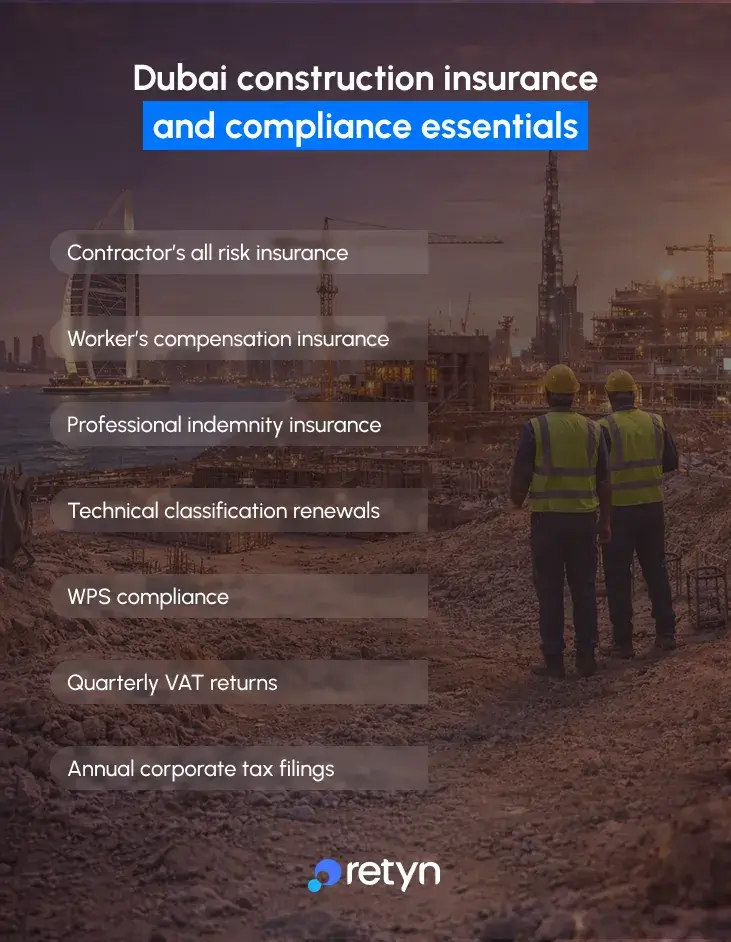
Step 10: Arrange mandatory construction & labor insurance
Construction is a high-risk industry in the UAE. To protect your company from massive liabilities and to secure Dubai Municipality permits, specific insurance policies are legally required.
Contractor’s All Risk (CAR) Insurance
Covers physical damage to the works, plant, and machinery, as well as third-party liability for property damage or bodily injury.
Worker’s Compensation Insurance
Mandatory under UAE Labor Law to cover medical expenses and lost wages for on-site labor and staff.
Professional Indemnity (PI)
Essential for companies providing design-build services to protect against claims of professional negligence or design errors.
Construction firms face more rigorous compliance than standard trading companies. Log these 2026 regulatory tasks to ensure your license remains active:
Trade Licence & DM Renewal
Annual renewal of both the DET (DED) license and the Dubai Municipality technical classification.
Wage Protection System (WPS)
Strict monthly requirement to pay all laborers through the Central Bank’s digital portal to avoid license blocks.
SOE Membership Renewals
Ensure all registered engineers renew their Society of Engineers (SOE) memberships to keep the classification valid.
VAT & Corporate Tax Filing
Submit quarterly VAT returns (5%) and annual Corporate Tax filings (9% on profits over AED 375k).
HSE Audits
Regular on-site safety audits by Dubai Municipality to maintain your "Contractor Rating."
Pro tip
Under the new 2026 "Small Projects" relief, construction companies with a turnover below AED 3 Million may be eligible for simplified Cash Basis Accounting for Corporate Tax.
Free 2026 construction setup checklist (Excel)
Keep track of DM technical exams, engineer visa quotas, and license milestones. Tap below and we'll WhatsApp the Excel sheet instantly.
Building a business is more than just paperwork; it’s about site safety. Dubai's 2026 building codes are among the strictest globally.
Failure to adhere to Health, Safety, and Environment (HSE) standards will result in immediate work-stop orders.
HSE Operations Manual
Develop a site-specific safety manual tailored to Dubai Municipality standards.
Qualified Safety Officers
For larger projects (G+4 and above), you must appoint a DM-approved Safety Officer.
Al Sa'fat – Green Building System
Compliance with Dubai’s "Al Sa'fat" system is mandatory to ensure sustainable and energy-efficient construction.
Pro tip
Implementing BIM (Building Information Modeling) software from Day 1 is no longer optional for high-tier contractors. In 2026, Dubai Municipality integrated BIM submittals as a prerequisite for G+6 building approvals.
Expert insight: The tech-driven evolution of Dubai’s construction sector
The four key drivers of transformation in Dubai’s construction industry for 2026 to 2029 are the “Al Sa’fat” Sustainable Building Codes, the revised Contractor Performance Rating System, BIM-enabled permit submittal processes and the Dubai 3D Printing Strategy 2030. Licence holders that adopt these regulatory changes and introduce green building technologies into their projects, implement BIM and digitise site safety systems will enhance their operational compliance. This is also likely to improve contractor performance ratings, support higher municipal classifications and increase eligibility for competitive government tender opportunities.
Below are four strategic levers for new construction entrepreneurs to utilize in order to navigate and respond to the technical changes mandated by DM and the Dubai 2040 Urban Master Plan.
Al Sa'fat 2.0 and Net-Zero Construction
DM mandates compliance with the Al Sa’fat Green Building System for all buildings requiring a municipal building permit. It establishes sustainability criteria for building design and construction and makes Al Sa’fat compliance a mandatory part of the building permit review process.
Strategy:
Add Building Energy Efficiency Services to the trade licence, enabling companies to provide compliant, efficiency-based services in line with Dubai Municipality’s Al Sa’fat regulations. This allows firms to bundle energy-efficient retrofitting and sustainability-compliant solutions with their construction and consultancy services, contributing to increased margins, faster approval timelines through Smart Pass and an enhanced competitive position in the market.
BIM-Integrated Permit Submittals
DM now requires Building Information Modelling (BIM) to be used when submitting structural permit applications for certain large and complex building projects (subject to approved standards). The use of BIM enhances the coordination and efficiency that occurs through technical review processes.
Licence-holders should invest in BIM-certified engineers early to lock in partnerships with tier-1 developers like Emaar and Nakheel.
The 25% 3D Printing Strategy
By 2030, at least 25% of all buildings in Dubai are expected to have been constructed using 3D printing technology. In order to stimulate the transition from conventional building methods to 3D-printed construction, municipal land fees will be discounted for pilot projects run by contractors holding a Specialized 3D Printing Contracting licence.
Strategy: Apply 3D printing to villas and structural elements to reduce labour costs by 50 to 80% and total construction costs by 50 to 70% while supporting Dubai’s long-term sustainability goals as outlined in the Dubai 2040 Urban Master Plan.
Unified Contractor Performance Rating
Law No. 7 of 2025 introduces the assessment of contractors through a single digital classification and performance framework regulated by DM. This framework evaluates technical capability as well as Health, Safety, and Environmental (HSE) compliance as part of overall contractor performance assessment.
Use digital site monitoring systems to automate daily safety logs, helping contractors maintain accurate safety documentation and compliance records in line with regulatory requirements.
Pro tip
Add a section on BIM-readiness and Al Sa'fat compliance to your pre-qualification document (PQD)—major developers now prioritize firms that can demonstrate energy-efficient modeling before the tender stage.
Decision snapshot – construction categories at a glance
Licence Category
Height Limit
Required Engineers*
Setup Time
Tendering Scope
Minimum Capital
G + 1 (Villas)
Ground + 1
1 Civil
≈ 10 weeks
Private Villas
AED 300k
G + 4 (Low-Rise)
Ground + 4
1 Civil
12 weeks
Apartments
AED 1M
G + 12 (Mid-Rise)
Ground + 12
2 Civil
14 weeks
Commercial
AED 5M
Unlimited (High-Rise)
No Limit
3 Senior
16 weeks+
Skyscrapers
AED 20M+
* "Required Engineers" refers to DM-registered technical staff with verified UAE experience.
** Minimum Capital is often verified by banks for credit facility issuance rather than DED paid-up capital.
Risk & penalty matrix – Key construction violations
Violation
Fine (AED)
Consequence
Working without DM Classification
50,000 - 100,000
Project shut down & blacklisting
Failure to provide Safety Equipment (PPE)
10,000 per worker
Suspension of labor quota
Operating outside Height Classification
100,000
Immediate license cancellation
Source: Dubai Municipality Construction Regulatory Schedule 2026.
Zero-tolerance is applied for safety and structural integrity breaches.
Starting construction before securing Building Permits (fines can exceed AED 200k).
Hiring engineers with non-attested degrees (they will fail the DM technical exam).
Using a Virtual Office (Construction licenses strictly require a physical warehouse or office Ejari).
Ignoring the Wage Protection System (WPS) (missing one month freezes your immigration portal).
Underestimating Insurance costs—Professional Indemnity and CAR are significant overheads.
Construction industry regulation & news updates · 2026
LicensingNew law introduced to regulate engineering consultancy firms and tightens licensing - 5 October 2025
Introduces strict licensing compliance and enforcement measures to regulate engineering consultancy practices and elevate sector standards.
ContractNew, stricter regulatory framework announced for contracting sector activities - 12 July 2025
Unified regulatory framework for contractor classification, licensing, oversight and strengthening governance in Dubai’s contracting sector.
Work PermitsMoHRE launches “Eye” AI system to automate work permit processing - 16 October 2025
MoHRE unveils an AI system that automatically checks and processes work-permit applications, cutting approval times and reducing errors.
SustainabilityRegion’s first legally binding climate accountability framework - 30 May 2025
Comprehensive legal framework for climate resilience, emissions reduction and climate accountability with penalties for non-compliance.
Digital TransformationNew certification introduced for people-focused buildings - 9 April 2025
Introduces new standards and a certification to improve quality of life through healthier, more comfortable and people-focused buildings.
Digital TransformationAI-driven digital transformation services accelerates infrastructure efficiency - 17 March 2025
Advanced technologies are reshaping infrastructure efficiency through AI-driven nd proactive services that reduce bureaucracy significantly.
Glossary of construction acronyms
DM - Dubai Municipality
DET - Department of Economy & Tourism
SOE - Society of Engineers
HSE - Health, Safety, and Environment
DEQ - Dubai Engineering Qualification (Exam)
WPS - Wage Protection System
DBC - Dubai Building Code
FAQs on starting a construction business in Dubai
It can take between 1 to 3 business days for initial trade licence approval after all required documentation has been received and processed by Dubai Government authorities. Additionally, prior to commencing any building activity, you will be required to obtain DM Technical Classification, which includes registering your engineering personnel with DM and passing the relevant technical competency exams.
No. The current UAE Commercial Companies Law now allows 100% foreign ownership in Building Contracting LLCs and therefore no longer requires a UAE National Partner to own at least 51% of the shares. However, should you register your company as a Civil Company (Consultancy), you will still be required to name a UAE National as a Local Service Agent (LSA).
In order to obtain a building permit, the applicant must be able to provide the following:
Contractor’s All Risk (CAR) Insurance: This insurance covers damage to the construction site as well as third-party liability.
Workmen's Compensation Insurance: This is mandatory in the UAE for all employees of contractors and engineers working at any site.
Professional Indemnity Insurance: This is required for design-and-build turnkey projects depending on the contract scope of works.
Decennial Liability: Statutory liability according to the UAE Civil Code that protects against defects in the structure of the building for up to ten years after completion.
You cannot go above your assigned category with the DM. If you want to be upgraded from G+1 (Villa) to G+4 (Low-Rise), then you must have at least one successfully completed villa project and appoint a licensed senior civil engineer. The engineer must have at least 5 years of documented experience in the field and must also pass a DM upgrade exam.
Construction is considered a high-risk sector and banks, therefore, require extensive documentation before opening a corporate account in Dubai. Typically, banks will ask for the final trade licence, DM Classification Certificate, an Ejari (Physical Office Lease), CVs of the technical team and a cash-flow forecast covering at least six months, including details of project mobilization plans.
Yes. The Technical Manager or Lead Engineer appointed as the Designated Technical Representative is required to take and pass the Dubai Engineering Qualification (DEQ) examination. If a DM-approved engineer is not listed in your licence, you cannot submit an application for building permits, nor can you begin working on-site.
The average annual cost of renewing a construction company’s licence in Dubai depends on office size and classification.
Licence Renewal (DET): Approximately AED 12,000 to AED 18,000, depending on the applicable market fees.
DM Classification Renewal: Ranges from AED 5,000 to AED 10,000.
Office Ejari: Minimum AED 25,000 (Physical office is mandatory).
Disclaimer: This guide is for informational purposes only and does not constitute legal or technical advice. Construction regulations in Dubai are updated frequently by DM and DET—always consult with a certified business setup consultant.
Ready to build your construction legacy in Dubai?
Our technical experts handle everything from DED licensing to Dubai Municipality technical classifications.